
An EV charger carries real electrical current, and it usually sits in a garage or driveway where kids ride bikes and pets wander. That mix is why safety deserves a few minutes of thought before the first charge. Most of the risk comes from everyday things: a cable left on the floor, a connector dropped in the driveway, or a plug a curious hand can reach.
Cables are the biggest everyday problem. A long cord across a garage floor is a trip hazard for kids and a tempting chew toy for puppies. A connector left dangling can get pulled down, stepped on, or picked up and mouthed. Damaged cables are worse. A frayed cord, cracked housing, or exposed pins can put someone in contact with live electricity, so stop using any charger that looks damaged and replace the part before you plug in again. A spare J1772 replacement cable is one way to have a swap ready, since it plugs in with no tools or wiring needed.
Weather adds another layer. Water, dust, and sunlight wear on ports and plugs over time. How well a charger handles rain depends on its enclosure rating, and that varies by model, so read the datasheet or manual instead of assuming. A waterproof fabric port cover, like the LZSTEC cover listed as keeping rain, snow, and dust off the charging port, helps keep the port clean between sessions. Check that it fits your vehicle before you buy.
Built-in protection helps, but it does not replace supervision. Home chargers are designed with ground-fault protection, and installation rules differ by region, so confirm the requirements for your area with a licensed electrician and your charger's manual. Most manuals also say children should not operate or play with the charger. Treat it like a power tool or a stove: something the adults handle, with a plan for keeping little hands and paws away.
Where to Install Your Charger Out of Reach
Where the charger sits matters as much as how you use it. Mounting the unit higher on the wall puts the handle and connector out of easy reach for small kids and most pets. Check your charger's manual for recommended mounting heights, because they vary by model. A licensed electrician can tell you what applies at your address and can place the charger so the cable reaches the car without crossing a walkway.
Pick a spot away from where kids actually play. Skip the garage wall near the bike rack, the ball bin, or the pet door. A back corner or the wall beside the parking spot, away from the door to the house, usually works better. Try to choose a spot where the cable runs straight to the charge port, so you don't have slack lying across the floor. Also keep the area clear of storage boxes and anything kids might climb to reach the unit.
If you can't mount the charger high enough, or you want a second layer, a lockable enclosure helps. The txxlgchh Wall-Mounted EV Charger Enclosure with Acrylic Window and Lock is an empty steel enclosure built to hold a Level 2 charger and its cables. It has a key lock to keep people from tampering with it, and the acrylic window lets you check the unit without opening the door. The interior measures 19.6 by 23.6 by 7.8 inches, so measure your charger and cable bundle first. Keep the key somewhere kids can't get to it, and check your charger's manual to confirm a closed box suits that model, since some units need airflow.

txxlgchh Wall-Mounted EV Charger Enclosure with Acrylic Window and Lock
A large gray steel box with a locking acrylic window that keeps your charger tucked away and protected outside.
Product information
Our review: 4.0 out of 5
Product links

If you use a portable charger, you still have a few placement choices. Plug it into an outlet that sits high on the wall rather than one near the floor, and keep the charger body off the ground, on a shelf or hook that pets can't knock down. Unplug it when you finish and put it away in a closed cabinet or a bag. Outdoors, keep outlets and connections out of standing water and puddles, and check the manual for what your unit can handle in wet weather.
Cable Habits That Protect Curious Kids and Pets
A charging cable is only a hazard when it ends up somewhere it shouldn't be, so the fix is a routine you repeat every time you plug in. When the session ends, pull the connector, hang it in its holder or holster if your charger has one, and get the cable off the floor. A loose coil on the concrete is what gets tripped over, chewed, or driven across.
Cable length matters more than people think. Extra slack is what ends up across the walkway. A charger like the Raylix Level 1 and 2 Portable EV Charger with a 21ft cord gives you room to reach the car without moving it far, but you still want to run the cord along a wall or the edge of the garage instead of straight across the middle. Pick a length that reaches your charge port with a little to spare, not one that leaves ten feet pooled on the floor.
Build a quick wind-up habit. Loop the cable in loose, even coils, the way you would a garden hose, and hang it on a hook mounted high on the wall. Skip tight bends and sharp kinks, since they can stress the cord over time. Never wrap it around the charger body if the manual says not to. Keep the connector end up and away from the floor, because that is the part a dog will grab or a toddler will pick up.
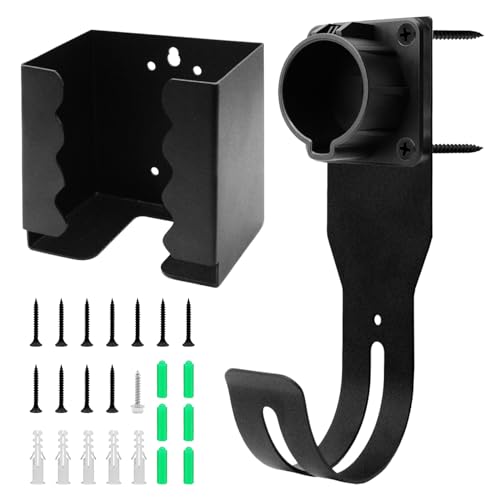
ZOSANY EV Charger Holster Wall Mount Kit with J-Hook Cable Holder
A black wall mount kit that holds your charger plug, cable and control box in one tidy spot.
Product information
Our review: 4.2 out of 5
Product links
Make a rule that kids don't handle the connector, and say it out loud so older kids know why. Adults plug in and unplug, and little ones stay clear. If a pet has chewed a cable, stop using it and don't touch the bare section while it is plugged in. Unplug it first, then call your vet if the animal may have been hurt, and replace the cable before charging again. If your charger has a swappable cord, a J1772 replacement cable that plugs in without tools is one option to keep on hand. Check that it matches your charger before you order.
A Quick Weekly Charger Safety Checklist
A weekly check takes about five minutes, and it catches the small problems before a kid or a pet finds them. Pick a day, like Sunday evening, and do it with the charger unplugged from the car and, for a portable unit, unplugged from the wall too. Never inspect a cable while it is live.
Start with the cable and connector. Run your hand along the whole cord and look for cracks, cuts, flattened spots, or bite marks. Look inside the connector end for bent or discolored pins, and check the housing for cracks or loose pieces. If you find any of that, replace the part before the next session. Then look at the wall plug and outlet. Warm, discolored, or loose-fitting plugs are a warning sign, so call a licensed electrician rather than keep using them.
Next, check the spots kids and pets reach. Is the cable hanging on its hook or holder, or has it ended up on the floor? Is anything stacked near the charger that a child could climb? If you use a lockable enclosure like the txxlgchh enclosure, confirm the door latches and the window still shows the unit clearly. Wipe away dust, cobwebs, and standing water around the charger and the outlet.
Finish with a quick test of the charger itself. Plug in, start a session, and watch that it begins normally and shows no error lights or messages. Your manual explains what each indicator means and what to do about a fault. If the charger trips, shuts off on its own, or acts strangely, leave it off until a qualified electrician or the manufacturer has looked at it. Jot the date on a sticky note near the charger so you can see when you last checked.


